


PFAS - Perfluoroalkyl & Polyfluoroalkyl Substances 2024

Background Information from the EPA
Perfluoroalkyl and polyfluoroalkyl substances (PFAS) are a group of man-made chemicals that include: PFOA, PFOS, GenX, and many other chemicals. PFAS have been manufactured and used in a variety of industries around the globe, including the United States since the 1940s. PFOA and PFOS have been the most extensively produced and studied of these chemicals. Both chemicals are very persistent in the environment and in the human body – meaning they don’t break down and they can accumulate over time. There is evidence that exposure to PFAS can lead to adverse human health effects.
PFAS can be found in:
- Food packaged in PFAS-containing materials, processed with equipment that used PFAS, or grown in PFAScontaminated soil or water.
- Commercial household products, including stain- and water-repellent fabrics, nonstick products (e.g., Teflon), polishes, waxes, paints, cleaning products, and fire-fighting foams (a major source of groundwater contamination at airports and military bases where firefighting training occurs).
- Workplace, including production facilities or industries (e.g., chrome plating, electronics manufacturing or oil recovery) that use PFAS.
- Drinking water, typically localized and associated with a specific facility (e.g., manufacturer, landfill, wastewater treatment plant, or firefighter training facility).
- Living organisms, including fish, animals and humans, where PFAS have the ability to build up and persist over time.
Certain PFAS chemicals are no longer manufactured in the United States as a result of phase outs including the PFOA Stewardship Program in which eight major chemical manufacturers agreed to eliminate the use of PFOA and PFOA-related chemicals in their products and as emissions from their facilities. Although PFOA and PFOS are no longer manufactured in the United States, they are still produced internationally and can be imported into the United States in consumer goods such as carpet, leather and apparel, textiles, paper and packaging, coatings, rubber and plastics.
Test Matrix Options
At this time, EMSL Analytical, Inc. is currently processing drinking water, ground water, wastewater, soil, and food matrices.
Test Methods
EMSL is setup for multiple methods:
- EPA 537 for drinking water
- EPA 537.1 for drinking water
- EPA 533 for drinking water
- EPA 1633 for ground water, wastewater, and soils
See PFAS in Food Testing Sheet
For information only purposes, EMSL can also offer a Modified EPA 537.1 that allows the customer to analyze water or soil matrices for between 2 to 40 different compounds.
Instrumentation
Solid Phase Extraction (SPE) and Liquid Chromatography/Tandem Mass Spectrometry (LC/MS/MS)
State of Origin - Certifications: Drinking Water Samples
EMSL is certified by the State of New Jersey (NJDEP 03036) for drinking water samples by method 537.1, and 533. EMSL currently holds national accreditation by A2LA (2845.01) for drinking water samples by method 533, and Modified 537.1.
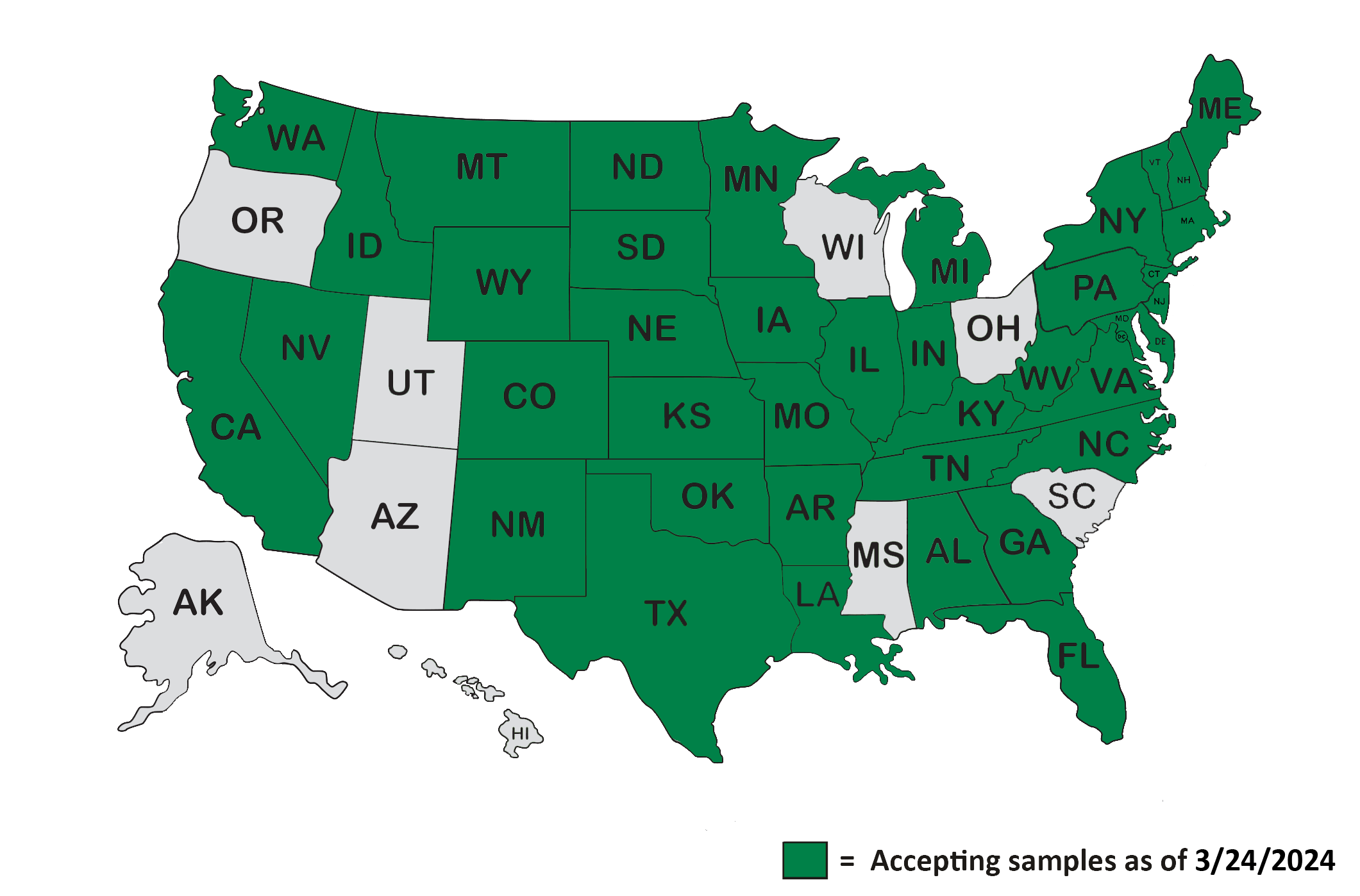
As of 03/24/2024, we are certified for drinking water samples and can accept samples from:
Alabama
California
Connecticut
Colorado
Florida
Georgia
Kentucky
Louisiana
Maine
Massachusetts
Michigan
Minnesota
Montana
Nebraska
Nevada
New Hampshire
New Jersey
New Mexico
New York
North Dakota
Oklahoma
Pennsylvania
Rhode Island
Vermont
Washington
West Virginia
As of 03/24/2024, there is no state certification for drinking water samples, so we can accept samples from:
Arkansas
Delaware
Idaho
Illinois
Indiana
Iowa
Kansas
Maryland
Missouri
North Carolina
South Dakota
Tennessee
Texas
Virginia
Wyoming
As of 03/24/2024, we cannot accept drinking water samples from:
Alaska
Arizona
Hawaii
Mississippi
Ohio
Oregon
South Carolina
Utah
Wisconsin
What is UCMR?
Unregulated Contaminant Monitoring Rule (UCMR) is designed as an exploratory program so the EPA can test out possible analysis options for contaminants regulations before they choose to regulate (or not regulate) them. In this case many states have already started certifying for PFAS well over a year before the UCMR rules, so this is not the typical way these things happen with new regulations. Example: New Jersey Department of Environmental Protection (NJDEP) certification will supersede the EPA, so UCMR listing is N/A in states that certify it themselves. UCMR fills a gap before contaminants are on the Safe Drinking Water Act (SDWA) list, so this will all change come next year but once a state certified for a parameter, UCMR is no longer applicable.
The program details are all here and you can see the program and PFAS are basically backwards in timeline.
https://www.epa.gov/dwucmr/learn-about-unregulated-contaminant-monitoring-rule
FROM THE EPA’s WEBSITE
Must testing laboratories be state-“certified” to analyze drinking water for PFAS? Are state certified laboratories available?
States generally certify laboratories that support drinking water compliance monitoring (i.e., for regulated contaminants). EPA does not currently regulate PFAS under the Safe Drinking Water Act and therefore does not have any laboratory certification requirements for PFAS. EPA is aware that some states offer programs for laboratories that wish to be certified to analyze drinking water samples using EPA PFAS methods. EPA is also aware that ISO 17025 accreditation bodies (“ILAC signatories”) offer such service for laboratories conducting non-regulatory monitoring or testing (such as PFAS testing). Lastly, EPA is aware that DOD manages a PFAS laboratory accreditation program.
https://www.epa.gov/pfas/epa-pfas-drinking-water-laboratory-methods
Instrumentation
Solid Phase Extraction (SPE) and Liquid Chromatography/Tandem Mass Spectrometry (LC/MS/MS)
State of Origin - Certifications: Soils, Groundwater and Wastewater Samples
EMSL is certified by State of New Jersey (NJDEP 03036) for soil, groundwater, and wastewater samples by method 1633. Multiple states do not certify soil, groundwater, or wastewater methods, so please see below.
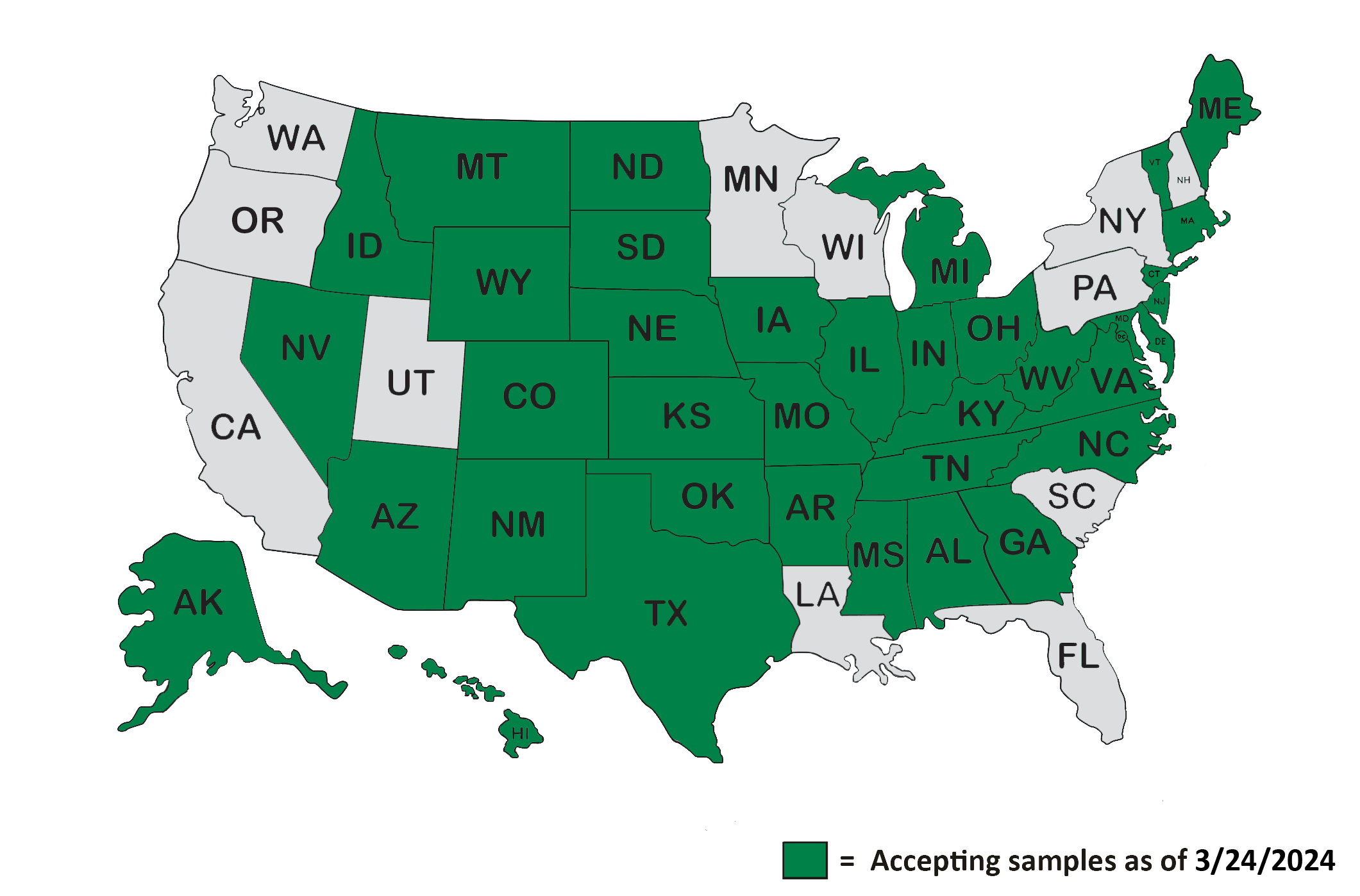
As of 03/24/2024, there is no state certification for soil samples, so we can accept samples from:
Alabama
Alaska
Arizona
Arkansas
Colorado
Connecticut
Delaware
Georgia
Hawaii
Idaho
Illinois
Indiana
Iowa
Kansas
Kentucky
Maine
Maryland
Massachusetts
Michigan
Mississippi
Missouri
Montana
Nebraska
Nevada
New Jersey
New Mexico
North Carolina
North Dakota
Ohio
Oklahoma
Rhode Island
South Dakota
Tennessee
Texas
Vermont
Virginia
West Virginia
Wyoming
As of 03/24/2024, we cannot accept soil samples from:
California
Florida
Louisiana
Minnesota
New Hampshire
New York
Oregon
Pennsylvania
South Carolina
Utah
Washington
Wisconsin
As of 10/11/2022: EPA Summary of State by State PFAS Resources
| Participating States | Type of Regulation | Concentration Level | |
|---|---|---|---|
| Alaska | Action Level | Adopt the EPA Standard: PFOS and PFOA combined (Notification and Guidance) | 70 ppt |
| California | Regulation | PFOA (Notification) | 5.1 ppt |
| PFOS (Notification) | 6.5 ppt | ||
| PFBS (Notification) | 500 ppt | ||
| Colorado | Translation Level | 3 PFAS substances combined: PFOS, PFOA, and PFNA (Guidance) | 70 ppt |
| PFHxS (Guidance) | 700 ppt | ||
| PFBS (Guidance) | 400,000 ppt | ||
| Connecticut | Health Advisory | 5 PFAS substances combined: PFOS, PFOA, PFHpA, PFHxS, and PFNA (Notification) | 70 ppt |
| Delaware | Guidance Policy | Adopt the EPA Standard: PFOS and PFOA combined (Notification and Guidance) | 70 ppt |
| Maine | Interim Drinking Water Standard | 6 PFAS substances combined: PFOA, PFOS, PFHxS, PFNA, PFHpA, and PFDA (Notification) | 20 ppt |
| Maryland | Health Advisory | PFHxS (Guidance) | 140 ppt |
| Massachusetts | Regulation | 6 PFAS substances combined: PFOA, PFOS, PFHxS, PFNA, PFHpA, and PFDA (MCL) | 20 ppt |
| Michigan | Regulation | PFNA (MCL) | 6 ppt |
| PFOA (MCL) | 8 ppt | ||
| PFOS (MCL) | 16 ppt | ||
| PFHxS (MCL) | 51 ppt | ||
| Gen X or HFPO-DA (MCL) | 370 ppt | ||
| PFBS (MCL) | 420 ppt | ||
| PFHxA (MCL) | 400,000 ppt | ||
| Minnesota | Health Advisory | PFOS (Guidance) | 15 ppt |
| PFOA (Guidance) | 35 ppt | ||
| PFHxS (Guidance) | 47 ppt | ||
| PFBS (Guidance) | 2,000 ppt | ||
| PFBA (Guidance) | 7,000 ppt | ||
| Nevada | Basic Comparison | PFOA and PFOS (Guidance) | 667,000 ppt |
| PFBS (Guidance) | 667,000,000 ppt | ||
| New Hampshire | Regulation | PFNA (MCL) | 11 ppt |
| PFOA (MCL) | 12 ppt | ||
| PFOS (MCL) | 15 ppt | ||
| PFHxS (MCL) | 18 ppt | ||
| New Jersey | Regulation | PFNA and PFOS (MCL) | 13 ppt |
| PFOA (MCL) | 14 ppt | ||
| New Mexico | Toxic Pollutant Standard | Adopt the EPA Standard: PFOS and PFOA combined (Notification and Guidance) | 70 ppt |
| New York | Regulation | PFOA and PFAS (MCL) | 10 ppt |
| North Carolina | Health Advisory | GenX or HFPO-DA (Guidance) | 140 ppt |
| Ohio | Statewide Action Plan | PFNA (Guidance) | 21 ppt |
| Adopt the EPA Standard: PFOS and PFOA combined (Notification and Guidance) | 70 ppt | ||
| PFHxS (Guidance) | 140 ppt | ||
| Gen X or HFPO-DA (Guidance) | 700 ppt | ||
| PFBS (Guidance) | 140,000 ppt | ||
| Oregon | Health Advisory | 4 PFAS substances combined: PFOS, PFOA, PFHxS, and PFNA (Guidance) | 30 ppt |
| Pennsylvania | Regulation | PFOA | 14 ppt |
| PFOS | 18 ppt | ||
| Vermont | Regulation | 5 PFAS substances combined: PFOA, PFOS, PFHpA, PFHxS, and PFNA (MCL) | 20 ppt |
| Washington | Rules | PFNA (Notification) | 9 ppt |
| PFOA (Notification) | 10 ppt | ||
| PFOS (Notification) | 15 ppt | ||
| PFHxS (Notification) | 65 ppt | ||
| PFBS (Notification) | 345 ppt |
Drinking Water Package Options by Compounds
| EMSL Test Codes | Compounds |
| C-PFNA | PFNA (Perfluorononanoic acid) |
| C-PFOA | PFOA (Perfluorooctanoic acid) |
| C-PFOS | PFOS (Perfluorooctanesulfonic acid) |
| C-PFAS 3 | PFNA (Perfluorononanoic acid) PFOA (Perfluorooctanoic acid) PFOS (Perfluorooctanesulfonic acid) |
| C-PFAS 14 | PFUnA (Perfluoroundecanoic acid) NEtFOSAA (N-ethyl perfluorooctanesulfonamidoacetic acid) NMeFOSAA (N-methyl perfluorooctanesulfonamidoacetic acid) PFBS (Perfluorobutanesulfonic acid) PFDA (Perfluorodecanoic acid) PFDoA (Perfluorododecanoic acid) PFHpA (Perfluoroheptanoic acid) PFHxS (Perfluorohexanesulfonic acid) PFHxA (Perfluorohexanoic acid) PFNA (Perfluorononanoic acid) PFOS (Perfluorooctanesulfonic acid) PFOA (Perfluorooctanoic acid) PFTA (Perfluorotetradecanoic acid) PFTrDA (Perfluorotridecanoic acid) |
| C-PFAS 18 | PFUnA (Perfluoroundecanoic acid) NEtFOSAA (N-ethyl perfluorooctanesulfonamidoacetic acid) NMeFOSAA (N-methyl perfluorooctanesulfonamidoacetic acid) PFBS (Perfluorobutanesulfonic acid) PFDA (Perfluorodecanoic acid) PFDoA (Perfluorododecanoic acid) PFHpA (Perfluoroheptanoic acid) PFHxS (Perfluorohexanesulfonic acid) PFHxA (Perfluorohexanoic acid) PFNA (Perfluorononanoic acid) PFOS (Perfluorooctanesulfonic acid) PFOA (Perfluorooctanoic acid) PFTA (Perfluorotetradecanoic acid) PFTrDA (Perfluorotridecanoic acid) PFUnA (Perfluoroundecanoic acid) 11Cl-PF3OUdS (11-chloroeicosafluoro-3-oxaundecane-1-sulfonic acid) 9Cl-PF3ONS (9-chlorohexadecafluoro-3-oxanone-1-sulfonic acid) ADONA (4,8-dioxa-3H-perfluorononanoic acid) GenX, HFPO-DA (Hexafluoropropylene oxide dimer acid) |
| C-PFAS 25 | 11Cl-PF3OUdS (11-Chloroeicosafluoro-3-oxaundecane-1-sulfonic acid) 9Cl-PF3ONS (9-Chlorohexadecafluoro-3-oxanonane-1-sulfonic acid) ADONA (4,8-Dioxa-3H-perfluorononanoic acid) GenX, HFPO-DA (Hexafluoropropylene oxide dimer acid) NFDHA (Nonafluoro-3,6-dioxaheptanoic acid) PFBA (Perfluorobutanoic acid) PFBS (Perfluorobutanesulfonic acid) 8:2FTS (1H,1H, 2H, 2H-Perfluorodecane sulfonic acid) PFDA (Perfluorodecanoic acid) PFDoA (Perfluorododecanoic acid) PFEESA (Perfluoro(2-ethoxyethane)sulfonic acid) PFHpS (Perfluoroheptanesulfonic acid) PFHpA (Perfluoroheptanoic acid) 4:2FTS (1H,1H, 2H, 2H-Perfluorohexane sulfonic acid) PFHxS (Perfluorohexanesulfonic acid) PFHxA (Perfluorohexanoic acid) PFMPA (Perfluoro-3-methoxypropanoic acid) PFMBA (Perfluoro-4-methoxybutanoic acid) PFNA (Perfluorononanoic acid) 6:2FTS (1H,1H, 2H, 2H-Perfluorooctane sulfonic acid) PFOS (Perfluorooctanesulfonic acid) PFOA (Perfluorooctanoic acid) PFPeA (Perfluoropentanoic acid) PFPeS (Perfluoropentanesulfonic acid) PFUnA (Perfluoroundecanoic acid) |
Ground Water, Wastewater, and Soil Options by Compounds
| EMSL Test Codes | Compounds |
| C-PFAS 40 | PFOA (Perfluorooctanoic acid) PFNA (Perfluorononanoic acid) PFOS (Perfluorooctanesulfonic acid) GenX, HFPO-DA (Hexafluoropropylene oxide dimer acid) PFBA (Perfluorobutanoic acid) PFPeA (Perfluoropentanoic acid) PFHxA (Perfluorohexanoic acid) PFHpA (Perfluoroheptanoic acid) PFDA (Perfluorodecanoic acid) PFUnA (Perfluoroundecanoic acid) PFDoA (Perfluorododecanoic acid) PFTrDA (Perfluorotridecanoic acid) PFTeDA (Perfluorotetradecanoic acid) PFBS (Perfluorobutanesulfonic acid) PFPeS (Perfluoropentanesulfonic acid) PFHxS (Perfluorohexanesulfonic acid) PFHpS (Perfluoroheptanesulfonic acid) PFNS (Perfluorononanesulfonic acid) PFDS (Perfluorodecanesulfonic acid) PFDoS (Perfluorododecanesulfonic acid) PFOSA (Perfluorooctanesulfonamide) MeFOSA (N-methylperfluorooctanesulfonamide) EtFOSA (N-ethylperfluorooctanesulfonamide) MeFOSE (N-methylperfluorooctanesulfonamidoethanol) EtFOSE (N-ethylperfluorooctanesulfonamidoethanol) MeFOSAA (N-methylperfluorooctanesulfonamidoacetic acid) EtFOSAA (N-ethylperfluorooctanesulfonamidoacetic acid) 4:2FTS (4:2 Fluorotelomersulfonic acid) 6:2FTS (6:2 Fluorotelomersulfonic acid) 8:2FTS (8:2 Fluorotelomersulfonic acid) ADONA (4,8-dioxa-3H-perfluorononanoic acid) 9Cl-PF3ONS (9-chlorohexadecafluoro-3-oxanonane-1-sulfonic acid 1) 11Cl-PF3OUdS (11-chloroeicosafluoro-3-oxaundecane-1-sulfonic acid 2) PFMPA (Perfluoro-3-methoxypropanoic acid) PFMBA (Perfluoro-3-methoxybutanoic acid) NFDHA (Nonafluoro-3,6-dioxaheptanoic acid) PFEESA (Perfluoro(2-ethoxyethane)sulfonic acid) 3:3FTCA (3-Perfluoropropyl propanoic acid) 5:3FTCA (5:3 Perfluorooctanoic acid) 7:3FTCA (3-Perfluoroheptyl propanoic acid) |
Sampling Kit
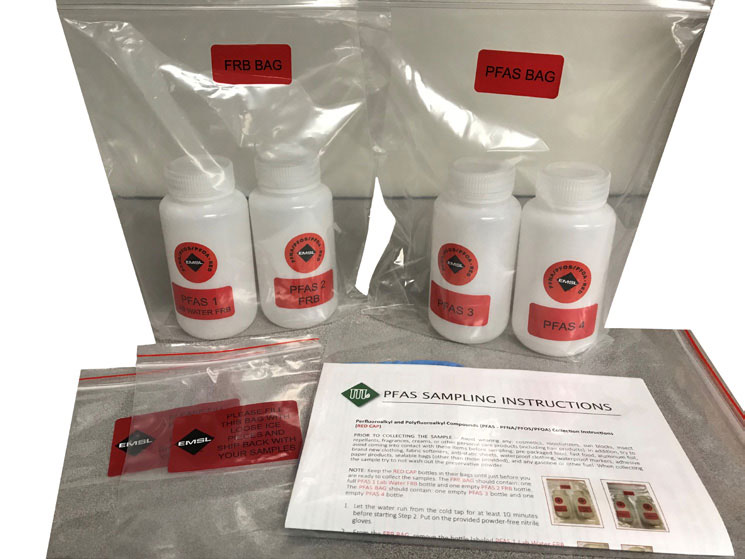
When collecting drinking water for analysis by EPA 537 or EPA 537.1 for each location collecting samples, the PFAS Sample Kit will include the following:
EMSL Product ID: 87LMCHEM006
2 PFAS sampling bottles with Trizma preservative inside
1 PFAS Lab Water Field Reagent Blank (FRB)
1 Empty PFAS FRB bottle
1 Bag for the 2 PFAS bottles
1 Bag for the 2 FRB bottles
When collecting drinking water samples for analysis by EPA 533, for each location collecting samples, the PFAS Sample Kit will include the following:
EMSL Product ID: 87LMCHEM007
3 PFAS sampling bottles with Ammonium Acetate preservative inside
1 PFAS Lab Water Field Reagent Blank (FRB)
1 Empty PFAS FRB bottle
1 Bag for the 3 PFAS bottles
1 Bag for the 2 FRB bottles
When collecting soil samples for analysis by EPA 1633 or Modified EPA 537.1, for each location collecting samples, please collect using a 500 ML (16 oz) HDPE wide mouth jar with no preservative.
EMSL Product ID: 87LMCHEM009
When collecting ground or wastewater samples for analysis by EPA 1633 or Modified EPA 537.1, for each location collecting samples, the PFAS Sample Kit will include the following:
EMSL Product ID: 87LMCHEM010
2 PFAS sampling bottles with no preservative inside
1 PFAS Lab Water Field Reagent Blank (FRB)
1 Empty PFAS FRB bottle
1 Bag for the 2 PFAS bottles
1 Bag for the 2 FRB bottles
Hold Times
14-Days for sample extraction from the date of collection
28-Days for the analysis from date of extraction
Sampling Instructions
(See sampling instructions sheet)
Test Packages
Please call you EMSL Sales Representative or our Customer Service Center at 800-220-3675.
Field Reagent Blanks (FRB)
Once a sample is analyzed, we are required to analyze the submitted Field Reagent Blank (FRB), if the reported value is greater than the Reporting Limit (>RL) per the method. The analyzed FRBs will be invoiced at the same cost as the regular sample.
Reporting
Current reporting for PFAS compounds will be the standard PDF report with results and Chain of Custody. For more advanced reporting (tier) packages, please contact your EMSL sales representative or customer service at 800-220-3675 for availability.


 English
 French
 Spanish
 Portuguese