


PFAS - Perfluoroalkyl & Polyfluoroalkyl Substances

Background Information from the EPA
Perfluoroalkyl and polyfluoroalkyl substances (PFAS) are a group of man-made chemicals that include: PFOA, PFOS, GenX, and many other chemicals. PFAS have been manufactured and used in a variety of industries around the globe, including the United States since the 1940s. PFOA and PFOS have been the most extensively produced and studied of these chemicals. Both chemicals are very persistent in the environment and in the human body – meaning they don’t break down and they can accumulate over time. There is evidence that exposure to PFAS can lead to adverse human health effects.
PFAS can be found in:
- Food packaged in PFAS-containing materials, processed with equipment that used PFAS, or grown in PFAScontaminated soil or water.
- Commercial household products, including stain- and water-repellent fabrics, nonstick products (e.g., Teflon), polishes, waxes, paints, cleaning products, and fire-fighting foams (a major source of groundwater contamination at airports and military bases where firefighting training occurs).
- Workplace, including production facilities or industries (e.g., chrome plating, electronics manufacturing or oil recovery) that use PFAS.
- Drinking water, typically localized and associated with a specific facility (e.g., manufacturer, landfill, wastewater treatment plant, or firefighter training facility).
- Living organisms, including fish, animals and humans, where PFAS have the ability to build up and persist over time.
Certain PFAS chemicals are no longer manufactured in the United States as a result of phase outs including the PFOA Stewardship Program in which eight major chemical manufacturers agreed to eliminate the use of PFOA and PFOA-related chemicals in their products and as emissions from their facilities. Although PFOA and PFOS are no longer manufactured in the United States, they are still produced internationally and can be imported into the United States in consumer goods such as carpet, leather and apparel, textiles, paper and packaging, coatings, rubber and plastics.
Test Matrix Options
At this time, EMSL Analytical, Inc. is currently processing drinking water, ground water, wastewater, soil, and food matrices.
Test Methods
EMSL is setup for multiple methods:
- EPA 537.1 for drinking water
- EPA 533 for drinking water
- EPA 1633 for ground water, wastewater, and soils
See PFAS in Food Testing Sheet
Instrumentation
Solid Phase Extraction (SPE) and Liquid Chromatography/Tandem Mass Spectrometry (LC/MS/MS)
State of Origin - Certifications: Drinking Water Samples
EMSL is a NELAP certified laboratory by the State of New Jersey (NJDEP 03036) for potable and non-potable water via EPA Methods 537.1 and 533. EMSL is nationally certified as ISO/IEC 17025 and TNI compliant by A2LA (2845.01) for potable and non-potable water via EPA Methods 537.1 and 533.
As of 01/01/2026, we are certified for drinking water samples and can accept samples from:
Alabama
California
Connecticut
Colorado
Delaware
Florida
Georgia
Hawaii
Indiana
Iowa
Kentucky
Louisiana
Maine
Maryland
Massachusetts
Michigan
Minnesota
Mississippi
Montana
Nebraska
Nevada
New Hampshire
New Jersey
New Mexico
New York
North Carolina
North Dakota
Oklahoma
Pennsylvania
Rhode Island
Texas
Vermont
Virginia
Washington
West Virginia
As of 01/01/2026, there is no state certification for drinking water samples, so we can accept samples from:
Arkansas
Idaho
Illinois
Kansas
Missouri
South Dakota
Tennessee
Wyoming
As of 01/01/2026, we cannot accept drinking water samples from:
Alaska
Arizona
Ohio
Oregon
South Carolina
Utah
Wisconsin

Instrumentation
Solid Phase Extraction (SPE) and Liquid Chromatography/Tandem Mass Spectrometry (LC/MS/MS)
State of Origin - Certifications: Soils, Groundwater and Wastewater Samples
EMSL is a NELAP certified laboratory by the State of New Jersey (NJDEP 03036) for potable and non-potable water via EPA Method 1633. EMSL is nationally certified as ISO/IEC 17025 and TNI compliant by A2LA (2845.01) for soil and sludge via EPA Method 1633.
As of 01/01/2026, we hold state specific certifications for soil and sludge samples in:
California
Florida
Louisiana
Minnesota
Nevada
New Jersey
New York
North Dakota
Pennsylvania
Virginia
Washington
As of 01/01/2026, there is no state certification for soil samples, so we can accept samples from:
Alabama
Arizona
Arkansas
Colorado
Connecticut
Delaware
Georgia
Hawaii
Idaho
Illinois
Indiana
Iowa
Kansas
Kentucky
Maine
Maryland
Michigan
Mississippi
Missouri
Montana
Nebraska
New Mexico
North Carolina
Oklahoma
Rhode Island
South Carolina
South Dakota
Tennessee
Vermont
West Virginia
Wyoming
As of 01/01/2026, we cannot accept soil samples from:
Alaska
Massachusetts
New Hampshire
Ohio
Oregon
Texas
Utah
Wisconsin

As of April 10, 2024 the EPA established legally enforceable levels, called Maximum Contaminant Levels (MCLs), for six PFAS in drinking water: PFOA, PFOS, PFHxS, PFNA, and HFPO-DA as contaminants with individual MCLs, and PFAS mixtures containing at least two or more of PFHxS, PFNA, HFPO-DA, and PFBS using a Hazard Index MCL to account for the combined and co-occurring levels of these PFAS in drinking water. EPA also finalized health-based, non-enforceable Maximum Contaminant Level Goals (MCLGs) for these PFAS. Not all states have adopted these lower MCLs, but EMSL meets them routinely
| Compound | Final MCLG | Final MCL (enforceable levels) |
|---|---|---|
| PFOA | Zero | 4.0 parts per trillion (ppt) (also expressed as ng/L) |
| PFOS | Zero | 4.0 ppt |
| PFHxS | 10 ppt | 10 ppt |
| PFNA | 10 ppt | 10 ppt |
| HFPO-DA (commonly known as GenX Chemicals) | 10 ppt | 10 ppt |
| Mixtures containing two or more PFHxS, PFNA, HFPO-DA, and PFBS | 1 (unitless) Hazard Index | 1 (unitless) Hazard Index |
Upcoming Timelines:
Public water systems must monitor for these PFAS and have three years to complete initial monitoring (by 2027), followed by ongoing compliance monitoring. Water systems must also provide the public with information on the levels of these PFAS in their drinking water beginning in 2027.
Public water systems have five years (by 2029) to implement solutions that reduce these PFAS if monitoring shows that drinking water levels exceed these MCLs.
Beginning in five years (2029), public water systems that have PFAS in drinking water which violates one or more of these MCLs must take action to reduce levels of these PFAS in their drinking water and must provide notification to the public of the violation.
Drinking Water Package Options by Compounds
| EMSL Test Codes | Compounds |
| C-PFNA | PFNA (Perfluorononanoic acid) |
| C-PFOA | PFOA (Perfluorooctanoic acid) |
| C-PFOS | PFOS (Perfluorooctanesulfonic acid) |
| C-PFAS 6 | PFNA (Perfluorononanoic acid) PFOA (Perfluorooctanoic acid) PFOS (Perfluorooctanesulfonic acid) PFHxS (Perfluorohaxanesulfonic acid) HFPO-DA, GenX (Hexafluoropropylene oxide dimer acid) PFBS (Perfluorobutanesulfonic acid) |
| C-PFAS 14 | PFUnA (Perfluoroundecanoic acid) NEtFOSAA (N-ethyl perfluorooctanesulfonamidoacetic acid) NMeFOSAA (N-methyl perfluorooctanesulfonamidoacetic acid) PFBS (Perfluorobutanesulfonic acid) PFDA (Perfluorodecanoic acid) PFDoA (Perfluorododecanoic acid) PFHpA (Perfluoroheptanoic acid) PFHxS (Perfluorohexanesulfonic acid) PFHxA (Perfluorohexanoic acid) PFNA (Perfluorononanoic acid) PFOS (Perfluorooctanesulfonic acid) PFOA (Perfluorooctanoic acid) PFTA (Perfluorotetradecanoic acid) PFTrDA (Perfluorotridecanoic acid) |
| C-PFAS 18 | PFUnA (Perfluoroundecanoic acid) NEtFOSAA (N-ethyl perfluorooctanesulfonamidoacetic acid) NMeFOSAA (N-methyl perfluorooctanesulfonamidoacetic acid) PFBS (Perfluorobutanesulfonic acid) PFDA (Perfluorodecanoic acid) PFDoA (Perfluorododecanoic acid) PFHpA (Perfluoroheptanoic acid) PFHxS (Perfluorohexanesulfonic acid) PFHxA (Perfluorohexanoic acid) PFNA (Perfluorononanoic acid) PFOS (Perfluorooctanesulfonic acid) PFOA (Perfluorooctanoic acid) PFTA (Perfluorotetradecanoic acid) PFTrDA (Perfluorotridecanoic acid) PFUnA (Perfluoroundecanoic acid) 11Cl-PF3OUdS (11-chloroeicosafluoro-3-oxaundecane-1-sulfonic acid) 9Cl-PF3ONS (9-chlorohexadecafluoro-3-oxanone-1-sulfonic acid) ADONA (4,8-dioxa-3H-perfluorononanoic acid) GenX, HFPO-DA (Hexafluoropropylene oxide dimer acid) |
| C-PFAS 25 | 11Cl-PF3OUdS (11-Chloroeicosafluoro-3-oxaundecane-1-sulfonic acid) 9Cl-PF3ONS (9-Chlorohexadecafluoro-3-oxanonane-1-sulfonic acid) ADONA (4,8-Dioxa-3H-perfluorononanoic acid) GenX, HFPO-DA (Hexafluoropropylene oxide dimer acid) NFDHA (Nonafluoro-3,6-dioxaheptanoic acid) PFBA (Perfluorobutanoic acid) PFBS (Perfluorobutanesulfonic acid) 8:2FTS (1H,1H, 2H, 2H-Perfluorodecane sulfonic acid) PFDA (Perfluorodecanoic acid) PFDoA (Perfluorododecanoic acid) PFEESA (Perfluoro(2-ethoxyethane)sulfonic acid) PFHpS (Perfluoroheptanesulfonic acid) PFHpA (Perfluoroheptanoic acid) 4:2FTS (1H,1H, 2H, 2H-Perfluorohexane sulfonic acid) PFHxS (Perfluorohexanesulfonic acid) PFHxA (Perfluorohexanoic acid) PFMPA (Perfluoro-3-methoxypropanoic acid) PFMBA (Perfluoro-4-methoxybutanoic acid) PFNA (Perfluorononanoic acid) 6:2FTS (1H,1H, 2H, 2H-Perfluorooctane sulfonic acid) PFOS (Perfluorooctanesulfonic acid) PFOA (Perfluorooctanoic acid) PFPeA (Perfluoropentanoic acid) PFPeS (Perfluoropentanesulfonic acid) PFUnA (Perfluoroundecanoic acid) |
Ground Water, Wastewater, and Soil Options by Compounds
| EMSL Test Codes | Compounds |
| C-PFAS 40 | PFOA (Perfluorooctanoic acid) PFNA (Perfluorononanoic acid) PFOS (Perfluorooctanesulfonic acid) GenX, HFPO-DA (Hexafluoropropylene oxide dimer acid) PFBA (Perfluorobutanoic acid) PFPeA (Perfluoropentanoic acid) PFHxA (Perfluorohexanoic acid) PFHpA (Perfluoroheptanoic acid) PFDA (Perfluorodecanoic acid) PFUnA (Perfluoroundecanoic acid) PFDoA (Perfluorododecanoic acid) PFTrDA (Perfluorotridecanoic acid) PFTeDA (Perfluorotetradecanoic acid) PFBS (Perfluorobutanesulfonic acid) PFPeS (Perfluoropentanesulfonic acid) PFHxS (Perfluorohexanesulfonic acid) PFHpS (Perfluoroheptanesulfonic acid) PFNS (Perfluorononanesulfonic acid) PFDS (Perfluorodecanesulfonic acid) PFDoS (Perfluorododecanesulfonic acid) PFOSA (Perfluorooctanesulfonamide) MeFOSA (N-methylperfluorooctanesulfonamide) EtFOSA (N-ethylperfluorooctanesulfonamide) MeFOSE (N-methylperfluorooctanesulfonamidoethanol) EtFOSE (N-ethylperfluorooctanesulfonamidoethanol) MeFOSAA (N-methylperfluorooctanesulfonamidoacetic acid) EtFOSAA (N-ethylperfluorooctanesulfonamidoacetic acid) 4:2FTS (4:2 Fluorotelomersulfonic acid) 6:2FTS (6:2 Fluorotelomersulfonic acid) 8:2FTS (8:2 Fluorotelomersulfonic acid) ADONA (4,8-dioxa-3H-perfluorononanoic acid) 9Cl-PF3ONS (9-chlorohexadecafluoro-3-oxanonane-1-sulfonic acid 1) 11Cl-PF3OUdS (11-chloroeicosafluoro-3-oxaundecane-1-sulfonic acid 2) PFMPA (Perfluoro-3-methoxypropanoic acid) PFMBA (Perfluoro-3-methoxybutanoic acid) NFDHA (Nonafluoro-3,6-dioxaheptanoic acid) PFEESA (Perfluoro(2-ethoxyethane)sulfonic acid) 3:3FTCA (3-Perfluoropropyl propanoic acid) 5:3FTCA (5:3 Perfluorooctanoic acid) 7:3FTCA (3-Perfluoroheptyl propanoic acid) |
Sampling Kit
When collecting drinking water for analysis by EPA 537.1 for each location collecting samples, the PFAS Sample Kit will include the following:
EMSL Product ID: 87LMCHEM006
2 PFAS sampling bottles with Trizma preservative inside
1 PFAS Lab Water Field Reagent Blank (FRB)
1 Empty PFAS FRB bottle
1 Bag for the 2 PFAS bottles
1 Bag for the 2 FRB bottles
When collecting drinking water samples for analysis by EPA 533, for each location collecting samples, the PFAS Sample Kit will include the following:
EMSL Product ID: 87LMCHEM007
3 PFAS sampling bottles with Ammonium Acetate preservative inside
1 PFAS Lab Water Field Reagent Blank (FRB)
1 Empty PFAS FRB bottle
1 Bag for the 3 PFAS bottles
1 Bag for the 2 FRB bottles
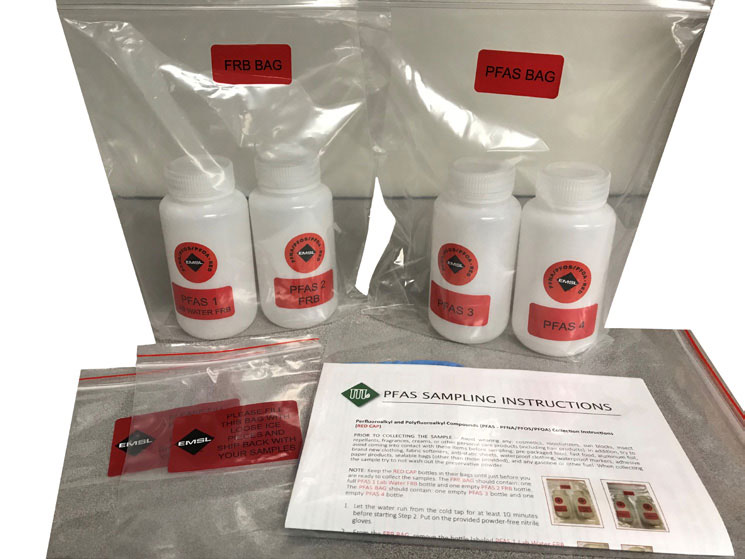
When collecting soil samples for analysis by EPA 1633, for each location collecting samples, please collect using a 500 ML (16 oz) HDPE wide mouth jar with no preservative.
EMSL Product ID: 87LMCHEM009
When collecting ground or wastewater samples for analysis by EPA 1633, for each location collecting samples, the PFAS Sample Kit will include the following:
EMSL Product ID: 87LMCHEM010
2 PFAS sampling bottles with no preservative inside
1 PFAS Lab Water Field Reagent Blank (FRB)
1 Empty PFAS FRB bottle
1 Bag for the 2 PFAS bottles
1 Bag for the 2 FRB bottles
Hold Times
14-Days for sample extraction from the date of collection
28-Days for the analysis from date of extraction
Sampling Instructions
(See sampling instructions sheet)
Test Packages
Please call you EMSL Sales Representative or our Customer Service Center at 800-220-3675.
Field Reagent Blanks (FRB)
Once a sample is analyzed, we are required to analyze the submitted Field Reagent Blank (FRB), if the reported value is greater than the Reporting Limit (>RL) per the method. The analyzed FRBs will be invoiced at the same cost as the regular sample.
Reporting
Current reporting for PFAS compounds will be the standard PDF report with results and Chain of Custody. For more advanced reporting (tier) packages, please contact your EMSL sales representative or customer service at 800-220-3675 for availability.


 English
 French
 Spanish
 Portuguese