


Radionuclides in Soil

Soil can be radiologically contaminated, either by naturally occurring radioactive materials (NORM) or manmade radionuclides. These radioactive materials can be taken up by crops or moved into drinking water by underground water, and pose health effects to human body. The U.S. Environmental Protection Agency (EPA) developed guidance for Screening Radionuclides in soil(1) to help standardize and accelerate the evaluation and cleanup of soils contaminated with radioactive materials at sites on the National Priorities List (NPL) with future residential land use. This guidance provides a methodology for environmental science/engineering professionals with a background in radiological risk assessment to calculate risk-based, site-specific, soil screening levels (SSLs) for radionuclides in soil that may be used to identify areas needing further investigation at NPL sites.
(1)Soil Screening Guidance for Radionuclides: User’s Guide. EPA/540-R-00-007, 2000
Principal Radionuclides of Concern
Uranium-238, Uranium-234, Thorium-232 and their daughter progenies are naturally occurring in rocks. Some rocks contain more radionuclides than others. When the radioactive-enriched rocks break down, a majority of radionuclides will primarily remain in the soil formed from these rocks.
The man-made radionuclides released from nuclear weapon tests and facilities that handle and process radioactive materials can also get into the soil. The most concerned of man-made radioactive materials include the nuclear fuels Uranium-235, Plutonium-238/239, Americium-241, Technetium and other synthetic radionuclides, including Cobalt-60, Strontium-89/90, Zirconium-95, Tc-99, Ruthenium-103/106, Iodine-131, Cesium-137, Lanthanum-140 and Cerium-144.
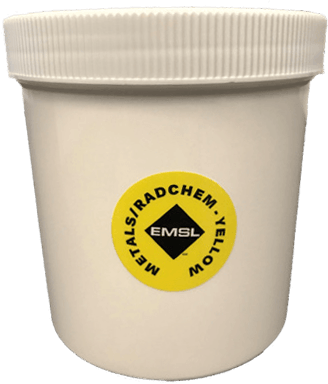
Soil Sampling Container
Sampling Container: 16 ounce wide mouth jar
EMSL Product ID: RADSOIL
Preservative: None
Shipping Requirements: No ice needed
Hold-Time: 6 months from collection
Detection Limit(s): Varies by method
Radiochemical Analysis of Radionuclides in Soil
| Group | Isotopes | Method | Detection Limit |
| NORM | Uranium-238 (U-238), Protactinium-334 (Pa-334m), Uranium-234 (U-234), Thorium-232 (Th-232), Radium-226 (Ra-226), Radium-228 (Ra-228) / Actinium -228 (Ac-228), Bismuth-214 (Bi-214), Lead-214 (Pb-214), Bismuth-212 (Bi-212), Thallium-208 (Tl-208), Lead-210 (Pb-210) and Potassium- 40 (K-40) | Gamma Spec | Americium-241 (Am-241): 50 (pCi/kg) Cesium-137 (Cs-137): 10 (pCi/kg) or Customer Specific Requests |
| Fission/ Activation Products | Cobalt-58 (Co-58)/ Cobalt-60 (Co-60), Zirconium-95 (Zr-95), Ruthenium-103/106 (Ru-103/106), Iodine -131 (I-131), Cesium-134/137 (Cs-134/137), Barium-140 (Ba-140), Lanthanum-140 (La-140) and Cerium-144 (Ce-144) |
||
| Select Actinides | * Thorium-232 (Th-232), Uranium-235 (U-235), Uranium-234/238 (U-/234/238), Plutonium-238 (Pu-238), Plutonium239/240 (Pu-239/240) and Americium-241 (Am-241) | Alpha Spec | 0.1 (pCi/g) |
| Strontium | * Strontium-90 (Sr-90), Strontium-89 (Sr-89) | Beta Count GFPC | 4 (pCi/g) 10 (pCi/g) |
| Technetium | Technetium-99 (Tc-99) | Beta Counting by Liquid Scintillation | 10 (pCi/g) |
| Tritium | Hydrogen-3 (H-3) | Beta Counting by Liquid Scintillation | 100 (pCi/g) |
Solid samples are placed into a can and sealed to prevent the escape of gasses. Activities of U-238 and Ra-228 were obtained from their daughter progenies at equilibrium. Ra-226 are measured and reported based on its decay product, Bi-214, as the equilibrium is achieved (21 days).
*Pricing available for individual isotopes, please call.
**The price is for standard turnaround time (TAT) of four weeks. An additional surcharge for sample preparation may apply for rock, concrete and other solid materials.
For more information, please contact EMSL’s laboratory personnel at info@EMSL.com.


 English
 French
 Spanish
 Portuguese