


Radiochemistry - Radium 226 and Radium 228
Radium (Ra) is a naturally occurring radioactive metal that exists as one of several isotopes. It is formed when uranium (U) and thorium (Th) decay in the environment. In the natural environment, radium is found at low levels in soil, water, rocks, coal, plants, and food. Over time, radium will decay and release radium-226, radium-228, and radium-224. While the half-life of radium-226 is very long at 1,600 years, the half-life of radium-228 is only 6.7 years and radium-224 is an even shorter 3.5 days.
As the different isotopes break down, they can enter the body through eating food, drinking water, or skin absorption. Over time exposure to these isotopes can lead to many potential diseases and cause internal damage to the body 1,2,3.
Radium 226 and 228: Why Does It Take so Long to Analyze?
The analysis of radium-226 and radium-228 involve the measurement of the rate of decay of the respective isotopes over time. Once samples are prepped, it takes time for the ingrowth isotope of radium-224, a daughter of radium-228, to decay. We can measure the radium-228 first and then the radium-226 after the radium-224 is mostly decayed. If a sample has a high level of radium-228 present, the time it takes to decay will be longer. Due to current technologies and instrumentation, there is no quicker way at this time to perform these analyses while achieving the required EPA detection levels.
The analysis is reported in a standard unit of picocuries per liter (pCi/L) or micrograms per liter (µg/L).
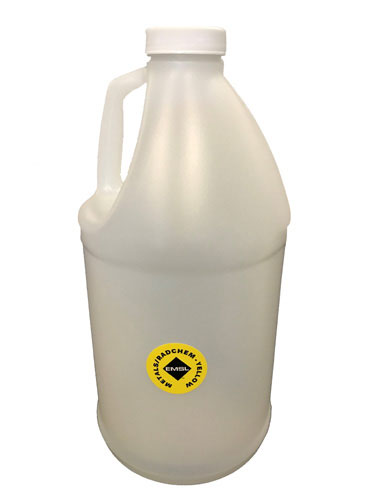
Water Sampling Container
Sampling Bottle: 2 L
EMSL Product ID: 8714201
Preservative: 5 mL nitric acid
Shipping Requirements: No ice needed
Hold-Time: 6 months from collection
Radium-226 Method EPA 904 Detection Limit: 1 pCi/L
Radium-228 Method EPA 903 Detection Limit: 1 pCi/L
Radiological Testing Guidelines
| Gross Alpha/Beta Results | Potential Contamination | Recommended Additional Test(s) |
|---|---|---|
| < 5 pCi/L | Background Levels | None |
| 5-15 pCi/L | Possible Radium | Radium 226 and 228 |
| > 15 pCi/L | Possible Radium and Uranium | Radium 226, 228, and Uranium |
Treatment Recommended If: |
||
| Radium-226 + Radium-228 > 5 pCi/L OR Gross Alpha – Uranium > 15 pCi/L OR Uranium > 30 µg/L |
||
| Safe Water Drinking Act (SDWA) Standards3,4 | Maximum Contaminant Limit (MCL) |
|---|---|
| Radium-226 + Radium-228 | 5 pCi/L |
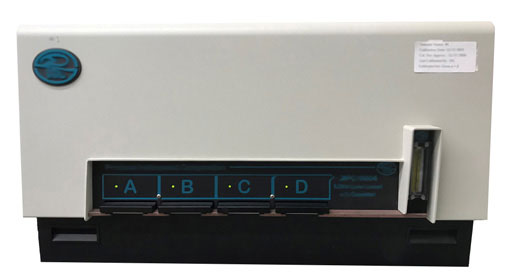
Alpha/Beta Counter
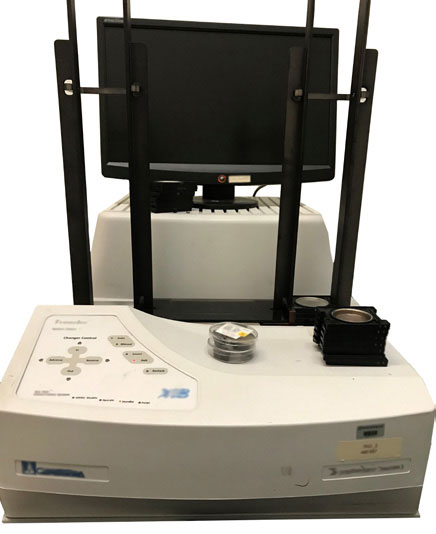
Alpha/Beta Counter
1 (Radium) – https://semspub.epa.gov/work/HQ/176334.pdf
2 (Radionuclides) – https://www.epa.gov/dwreginfo/radionuclides-rule
3 (Radionuclides) – https://nepis.epa.gov/Exe/ZyPDF.cgi?Dockey=30006644.txt
CAUTION:
Sampling bottles contain nitric acid as a preservative which can easily burn your skin and clothes. Please use gloves when handling bottles, avoid overfilling the bottles, and splashing the contents on you.
What is an isotope?
Any of two or more species of atoms of a chemical element with the same atomic number and nearly identical chemical behavior but with differing atomic mass or mass number and different physical properties.
What is a half-life?
The time required for a radioactive substance to lose 50 percent of its radioactivity by decay is known as the half-life.
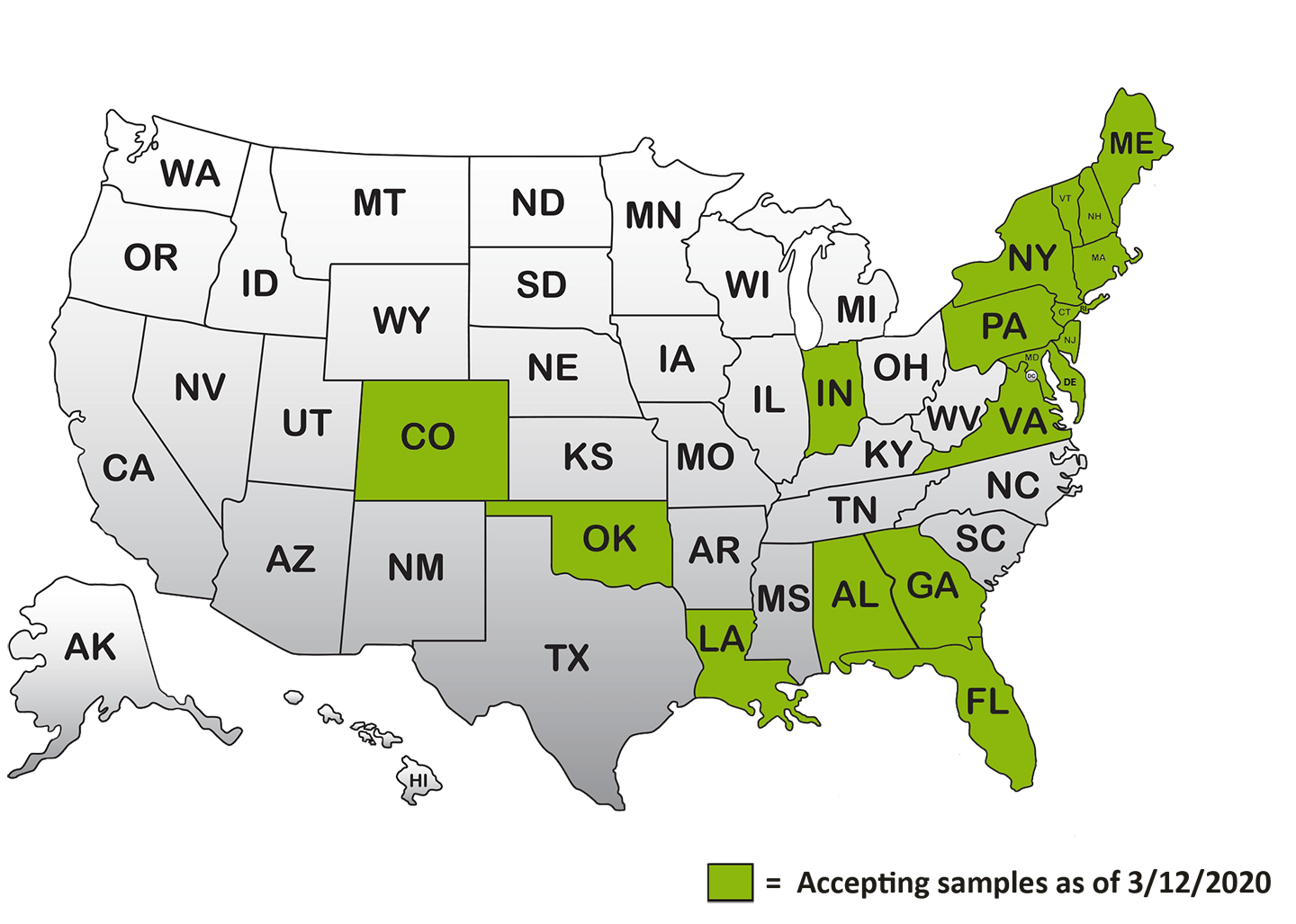
State of Origin
As of 03/12/2020, we can accept samples from:
| Alabama | Indiana | New York |
| Colorado | Louisiana | Oklahoma |
| Connecticut | Maine | Pennsylvania |
| Delaware | Maryland | Rhode Island |
| District of Columbia | Massachusetts | Vermont |
| Florida | New Hampshire | Virginia |
| Georgia | New Jersey |
As of 03/12/2020, we cannot accept samples from:
| Alaska | Minnesota | Oregon |
| Arizona | Missouri | South Carolina |
| Arkansas | Mississippi | South Dakota |
| California | Montana | Tennessee |
| Hawaii | Nebraska | Texas |
| Idaho | Nevada | Utah |
| Illinois | New Mexico | Washington |
| Iowa | North Carolina | West Virginia |
| Kansas | North Dakota | Wisconsin |
| Kentucky | Ohio | Wyoming |
| Michigan |


 English
 French
 Spanish
 Portuguese