


ERMI Interpretation Guidelines

ERMI Analysis – EMSL Test Code: M180
Your ERMI results do not denote or represent a medical or clinical diagnosis or conclusion. Interpretation of the data is the responsibility of the client.
Analytical Laboratory
EMSL Analytical, Inc. (EMSL) is a nationwide, full service, analytical testing laboratory network providing Asbestos, Mold, Indoor Air Quality, Microbiological, Environmental, Chemical, Forensic, Materials, Industrial Hygiene and Mechanical Testing services since 1981. Ranked as the premier independently owned environmental testing laboratory in the nation, EMSL puts analytical quality as its top priority. This quality is recognized by many well-respected federal, state and private accrediting agencies, such as AIHA’s EMLAP and EMPAT programs, and assured by our high quality personnel, including many Ph.D. microbiologists and mycologists.
EMSL is an independent laboratory that performed the analysis of these samples. EMSL did not conduct the sampling or site investigation for this report. The samples referenced herein were analyzed under strict quality control procedures using state-of-the-art molecular methods.
Analytical Method
Mold specific quantitative polymerase chain reactions (MSQPCR) was developed by a team of EPA researchers. MSQPCR utilizes EPA-patented molecular diagnostics methods for detecting and quantifying species of mold. The benefits of this technology include:
- A fast, accurate, and sensitive DNA-based analytical method for identifying and quantifying molds to the species level.
- Looks for the presence of DNA sequences that are unique to a particular mold species.
- Utilizes a DNA sequence detection system to monitor the presence and concentration of a specific mold in “REAL TIME”. As a mold-unique sequence is detected and amplified, fluorescent signal molecules are simultaneously released and measured. No fluorescence means no target mold present.
- DNA is a nucleic acid that carries the genetic information that is unique to every organism. DNA sequences determine individual hereditary characteristics.
- DNA can be found in every cell in every living (or previously living) organism. For example, humans have DNA in their skin cells and blood cells and fungi have DNA in their spores and hyphae.
ERMI Development
EPA researchers developed the Environmental Relative Moldiness Index (ERMI) in order to standardize the sampling and analytical methods available to indoor air quality consultants, researchers, and homeowners. The long term goal is to help better understand the risks of mold exposure to the health of occupants. The ERMI specifically measures the mold-burden in a home. The ERMI consists of values of 36 molds broken down into two groups, 26 in group 1; that represented the species associated with water-damage environments, and 10 species in group 2; that are considered common mycoflora in homes.
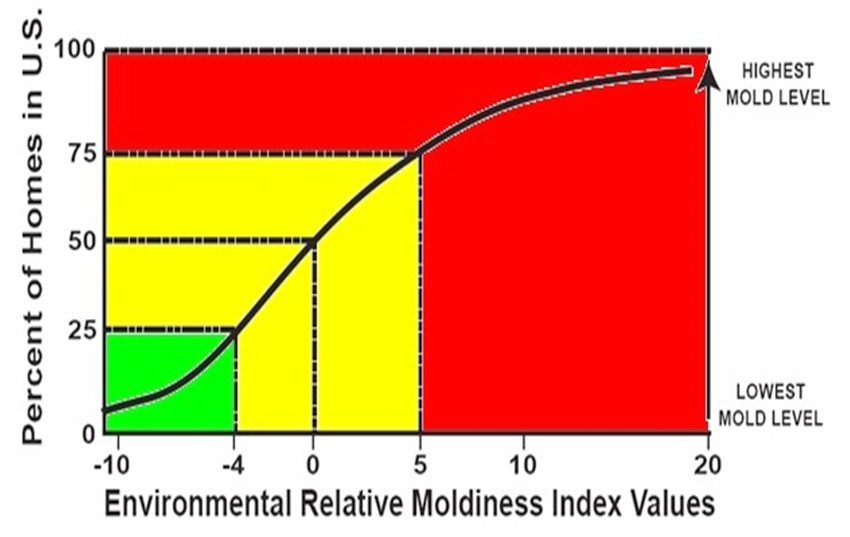
The US Department of Housing and Urban Development conducted the American Health Homes Survey in 2006. As part of the study, dust samples were collected from the bedroom and living room of 1096 homes across the US. Each composite sample was tested by MSQPCR for the ERMI. From this study, researchers were able to develop the following ERMI scale:
Understanding the Results
EMSL Analytical, Inc. is an independent laboratory, providing unbiased and scientifically valid results. These data represent only a portion of an overall IAQ investigation. Visual information and environmental conditions measured during the site assessment (humidity, moisture readings, etc.) are crucial to any final interpretation of the results. Many factors impact the final results; therefore, report data interpretation should be conducted with caution.
ERMI Interpretation
The mold burden of a home can be defined by two factors; the quantity of each mold species and the diversity of species present. The ERMI takes into account both of these factors and measures the long term mold burden. A relatively new water damage event with ensuing mold growth may not be detected by the ERMI, as the spores must undergo an equilibration period as they become incorporated in settled dust around the home. Other changes in the home, such as new carpets, must be interpreted in conjunction with the ERMI results.
Also the ERMI uses a combination of 36 molds to determine the mold burden in a home and does not rely only on one or two species. Homes with an ERMI Level 3 are more likely to have a mold problem. Home with an ERMI Level 4 have the greatest likelihood of having mold problems. Homes with an ERMI Level 2 are less likely of having a mold problem and homes with an ERMI Level 1 are least likely of having a mold problem.
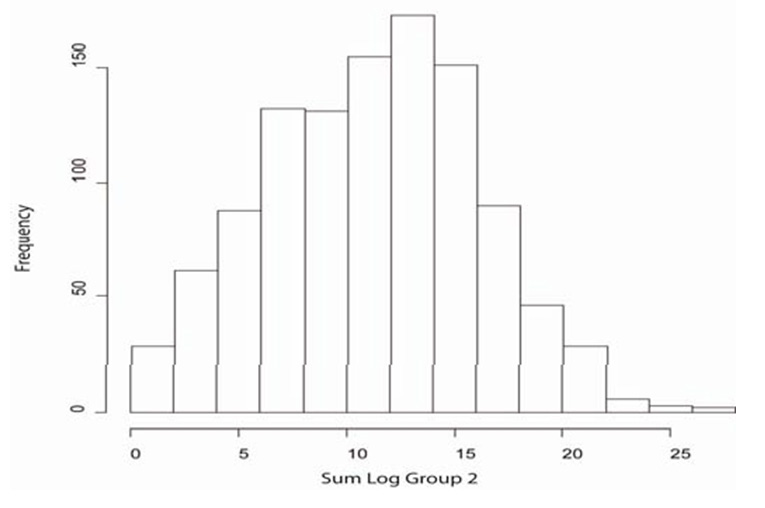
The above figure at right shows the distribution of the sum of the logs of the Group 2 species from the American Health Homes Survey conducted by HUD. If the reported Group 2 value falls toward the outside of either end of this scale then a reason must be sought. For example, if your Group 2 value is 1, this means there are fewer common molds than we would have expected in a normal home. Perhaps it is a new construction or recently remediated environment. If you have a very high group two value (>20), it may be possible that the home is contaminated with species found in Group 2 and is not representative of normal background levels.
It is generally accepted in the industry that indoor fungal growth is undesirable and inappropriate, necessitating removal or other appropriate remedial actions. The New York City guidelines and EPA guidelines for mold remediation in schools and commercial buildings define the conditions warranting mold remediation. Always remember that water is the key. Preventing water damage or water condensation will prevent mold growth.
This report is not intended to provide medical advice or advice concerning the relative safety of an occupied space. Always consult an occupational or environmental health physician who has experience addressing indoor air contaminants if you have any questions.
ERMI Calculation
The presence of each of the mold species is determined by MSQPCR and its quantity expressed as cell equivalents per mg of dust. The sum of the log of each group is calculated and group 2 is subtracted from group 1 giving the final ERMI value on your report.
| Group 1 | Group 2 |
| Aspergillus flavus Aspergillus fumigatus Aspergillus niger Aspergillus ochraceus Aspergillus penicillioides Aspergillus restrictus Aspergillus sclerotiorum Aspergillus sydowii Aspergillus unguis Aspergillus versicolor Eurotium (A.) amstelodami Aurobasidium pllulans Chaetomium globosum Cladosporium sphaerospermum Paecilomyces variotii Penicillim brevicompactum Penicillim corylophilum Penicillim crustosum (group 2) Penicillium purpurogenum Penicillium spinulosum Penicillium variabile Scopulariopsis brevicaulis Scopulariopsis chartarum Stachybotrys chartarum Trichoderma viride Wallemia sebi | Acremonium strictum Alternaria alternate Aspergillus ustus Cladosporium cladosporioides I Cladosporium cladosporioides II Cladosporium herbarum Epicoccum nigrum Mucor and Rhizopus group Penicillium chrysogenum Rhizopus stolonifera |
Detection of multiple organisms in real-time q-PCR assays
Certain species of mold are too genetically similar to be distinguished by MSQPCR. Thus positive or negative detection of any of these molds also suggests positive or negative detection of their genetically similar counterparts.
Eurotium (Aspergillus) amstelodami/ chevalieri/ herbariorum/ rubrum/ repens
Aspergillus flavus/ oryzae
Aspergillus niger/ foetidus/ phoenicus
Aspergillus restrictus/ caesillus/ conicus
Mucor and Rhizopus group/ Mucor/ amphibiorum/ circinelloides/ heimalis/ indicus/ mucedo/ racemous/ ramosissimus and Rhizopus azygosporus/ homothalicus/ microspores/ oligosporus/ oryzae
Penicillium chrysogenum/ griseofulvum/ glandicola/ coprophilum/ expansum and Eupenicillium crustaceum/ egyptiacum
Penicillim crustosum/ camembertii/ commune/ echinulatum/ solitum
Penicillium spinulosum/ glabrum/ lividum/ thomii/ purpurescens
Scopulariopsis brevicaulis/ fusca
Trichoderma viride/ atroviride/ koningii
Positive and negative Controls
A positive control is performed with every sample to prevent false negatives and to ensure the success of PCR amplification. An internal sample control is performed with every sample to test the success of DNA extraction and presence of inhibitors. It is also used for quantitative purposes. Negative controls are performed for each species tested for each client project in order to rule out laboratory contamination as the source of any positively detected molds and to prevent false positives. These controls are necessary to ensure quality results.
References and Informational Links
Articles
Quantification of Stachybotrys chartarum conidia in indoor dust using real time, fluorescent probe-based detection of PCR products. 2001. Jennie D Roe, Richard A Haugland, Stephen J Vesper and Larry J Wymer. JEAEE Vol. 11.
Rapid Monitoring by Quantitative Polymerase Chain Reaction for Pathogenic Aspergillus During Carpet Removal From a Hospital. 2004. Alice N. Neely, PhD, Vince Gallardo, MS, Ed Barth, MS, Richard A. Haugland, PhD, Glenn D. Warden, MD, and Stephen J. Vesper, PhD. Infection Control and Hospital Epidemiology, Vol. 23.
Quantitative Polymerase Chain Reaction Analysis of Fungi in Dust From Homes of Infants Who Developed Idiopathic Pulmonary Hemorrhaging. 2004. Vesper, Stephen J. PhD; Varma, Manju PhD; Wymer, Larry J. MS; Dearborn, Dorr G. MD, PhD; Sobolewski, John MS; Haugland, Richard A. PhD. Journal of Occupational & Environmental Medicine. 46(6):596-601.
Real-time PCR analysis of molds is performed at EMSL Analytical, Inc. in agreement with the Patent License Agreement between EMSL Analytical, Inc. and the United States Environmental Protection Agency’s National Exposure and Research Laboratory-CI as well as the Patent License Agreement between EMSL Analytical, Inc. and Applied Biosystems.
For further technical information regarding the development of the Environmental Relative Moldiness Index refer to the April 2006 issue of the “The Synergist” pages 39-43 or www.epa.gov/iaq
Books
Bioaerosols: Assessment and Control. Janet Macher, Ed., American Conference of Governmental Industrial Hygienists, Cincinnati, OH 1999.
Exposure Guidelines for Residential Indoor Air Quality. Environmental Health Directorate, Health Protection Branch, Health Canada, Ottawa, Ontario, 1989.
Fungal Contamination in Public Buildings: Health Effects and Investigation Methods. Health Canada, Ottawa, Ontario, 2004.
IICRC: S500 Standard and Reference Guide for Professional Water Damage Restoration. 3rd Edition, Institute of Inspection, Cleaning, and Restoration Certification, Vancouver, WA, 2006
IICRC: S520 Standard and Reference Guide for Professional Mold Remediation. 1st Edition, Institute of Inspection, Cleaning, and Restoration Certification, Vancouver, WA 2004
Field Guide for the Determination of Biological Contaminants in Environmental Samples. 2nd Edition, American Industrial Hygiene Association, 2005.
Consumer Links
Read the full text of AIHA’s “The Facts About Mold” consumer brochure.
http://www.aiha.org/content/accessinfo/consumer/factsaboutmold.htm
The Occupational Safety and Health Administration (OSHA)
http://www.osha.gov/SLTC/molds/index.html
CDC Mold Facts
http://www.cdc.gov/mold/faqs.html
CDC Stachybotrys – Questions and answers on Stachybotrys chartarum and other molds
http://www.cdc.gov/nceh/airpollution/mold/stachy.htm
IOM, NAS: Clearing the Air: Asthma and Indoor Air Exposures
http://fermat.nap.edu/books/0309064961/html/index.html
National Library of Medicine-Mold website
http://www.nlm.nih.gov/medlineplus/molds.html
California Department of Health Services (CADOHS)
http://www.cal-iaq.org/mold0107.html
Minnesota Department of Health
http://www.health.state.mn.us/divs/eh/indoorair/mold/indes.html
New York City Department of Health and Mental Hygiene
http://www.nyc.gov/html/doh/html/epi/moldrpt1.shtml
H.R.: The United States Toxic Mold Safety and Protection Act
http://www.house.gov/conyers/mold/htm
EPA
“Should You Have the Air Ducts in Your Home Cleaned?”
http://www.epa.gov/iaq/pubs/airduct.html
“Fact Sheet: Flood Cleanup – Avoiding Indoor Air Quality Problems”
http://www.epa.gov/iaq/pubs/flood.html
General information about molds and actions that can be taken to clean up or prevent a mold problem.
http://www.epa.gov/iaq/asthma/triggers/molds.html
“A Brief Guide to Mold, Moisture, and Your Home” Includes basic information on mold, cleanup guidelines, and moisture and mold prevention
http://www.epa.gov/iaq/molds/moldguide.html
“Mold Remediation in Schools and Commercial Buildings” – Information on remediation in schools and commercial property, references for potential mold and moisture remediators.
http://www.epa.gov/iaq/molds/mold-remediation.html
FEMA
“Homes That Were Flooded May Harbor Mold Problems” – Information and tips for cleaning mold.
http://www.fema.gov/diz01/d1364n18.shtm
“Mold Can Damage Home and Health” – How to check for mold, potential health effects of mold, and how to treat mold in the home
http://www.fema.gov/diz01/d1379n41.shtm
“Prompt Flood Cleanup Can Help Prevent Health Problems: – How to clean up in-house mold problems (not large or serious exposures).
http://www.fema.gov/diz99/d1279n09.shtm
Important Terms, Conditions, Limitations
Sample Retention
Samples analyzed by EMSL will be retained for 60 days after analysis date. Storage beyond this period is available for a fee with written request prior to the initial 30 day period. Samples containing hazardous/toxic substances which require special handling will be returned to client immediately. EMSL reserves the right to charge a sample disposal fee or return samples to the client.
Change Orders and Cancellation
All changes in the scope of work or turnaround time requested by the client after sample acceptance must be made in writing and confirmed in writing by EMSL. If requested changes result in a change in cost the client must accept payment responsibility. In the event work is cancelled by a client, EMSL will complete work in progress and invoice for work completed to the point of cancellation notice. EMSL is not responsible for holding times that are exceeded due to such changes.
Warranty
EMSL warrants to its clients that all services provided hereunder shall be performed in accordance with established and recognized analytical testing procedures and with reasonable care in accordance with applicable federal, state and local laws. The foregoing express warranty is exclusive and is given in lieu of all other warranties, expressed or implied. EMSL disclaims any other warranties, express or implied, including a warranty of fitness for particular purpose and warranty of merchantability.
Limits of Liability
In no event shall EMSL be liable for indirect, special, consequential, or incidental damages, including, but not limited to, damages for loss of profit or goodwill regardless of the negligence (either sole or concurrent) of EMSL and whether EMSL has been informed of the possibility of such damages, arising out of or in connection with EMSL’s services thereunder or the delivery, use, reliance upon or interpretation of test results by client or any third party. We accept no legal responsibility for the purposes for which the client uses the test results. EMSL will not be held responsible for the improper selection of sampling devices even if we supply the device to the user. The user of the sampling device has the sole responsibility to select the proper sampler and sampling conditions to insure that a valid sample is taken for analysis. Any resampling performed will be at the sole discretion of EMSL, the cost of which shall be limited to the reasonable value of the original sample delivery group (SDG) samples. In no event shall EMSL be liable to a client or any third party, whether based upon theories of tort, contract or any other legal or equitable theory, in excess of the amount paid to EMLS by the client thereunder.


 English
 French
 Spanish
 Portuguese